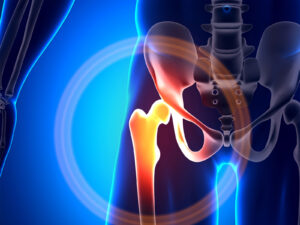
Orthopaedic Innovation

Rapid Recovery Hip Replacement for High BMI Patients

Hip Replacement When You’ve Been Told Your Weight is a Problem

You shouldn’t have to live with disabling hip pain while waiting to become “the right size” for surgery.

Find out if Rapid Recovery Hip Replacement is right for you. Speak to a surgeon within 48 hours.

Been Told You Need to Lose Weight Before Hip Replacement?

You may have more options than you’ve been told.

If hip pain is stopping you from walking, sleeping, exercising or enjoying everyday life, being told to “lose weight first” can feel like you're stuck in a cycle - especially when the pain itself makes it harder to stay active.

At Orthopaedic Innovation, we assess each patient individually. Our minimally invasive Kley Rapid Hip approach has been used to treat many patients with higher BMI, including some people who have previously been considered unsuitable for hip replacement elsewhere.

BMI is an important consideration in hip replacement surgery, but it isn't the only consideration. Our specialist team assesses your overall health, mobility, medical history, hip condition and individual circumstances before deciding whether Rapid Recovery Hip Replacement is appropriate.
ACL repair and reconstruction surgery London

Is your BMI too high for hip replacement?

BMI is one consideration - not the whole decision.

If you've already been told that your BMI is too high for surgery, you're not alone.

For some patients, higher BMI can increase the complexity and risks associated with joint replacement surgery. That's why careful assessment matters.

But BMI is only one part of the picture.

Your overall health, mobility, medical history, hip condition, fitness, medications and individual anatomy all need to be considered when deciding whether surgery is appropriate.

Our specialist team has extensive experience treating patients with higher BMI and more complex circumstances. Rather than assuming you are unsuitable based on a single number, we'll assess whether the Kley Rapid Hip approach could be appropriate for you.

What our patients have to say.

"No one wanted to operate because I was slightly overweight."

Meet Susan. Susan had been living with severe hip pain and had been told to lose weight before anyone would consider replacing her hips. She had been to the NHS and other doctors time and time again.

She eventually underwent bilateral hip replacement with the Orthopaedic Innovation team, and it gave her her life back.

Susan

When hip pain makes losing weight harder

You've probably heard the advice before:

Lose weight. Exercise more. Strengthen your muscles. Then we'll look at surgery.

But severe hip arthritis can make that advice incredibly difficult to follow.

Walking hurts.
Exercise becomes harder.
Sleep suffers.
Your mobility decreases.
And everyday activity can become exhausting.

For some people, this creates a frustrating cycle where the very pain that makes weight management important also makes movement increasingly difficult.

That's why we believe the conversation should start with your whole health picture, rather than BMI alone.

Our team can assess your hip, your general health and your individual circumstances and explain what options may be available to you.

Why patients choose Orthopaedic Innovation for hip replacements

Our highly experienced, expert surgical team is the only group in the UK performing the Kley Rapid Hip approach.
  • Specialist expertise: Led by Dr. Kristian Kley, with extensive experience in rapid recovery hip replacement.
  • 3,000+ hip procedures: Dr Kley has performed more than 3,000 procedures using the technique across Europe and the UK.
  • Two consultant surgeons: Two members of the specialist surgical team are present during the procedure.
  • Rapid access: Patients can typically undergo surgery within 1-2 weeks of their initial consultation, subject to suitability.
  • Designed around recovery: Minimally invasive, muscle-sparing surgery with early mobilisation and home recovery.
  • Price certainty: All-inclusive, transparent surgery pricing, with no hidden costs.

Benefits of Kley Rapid Hip and why it might be different for patients with a higher BMI

The Kley Rapid Hip approach is designed specifically around minimally invasive access. It reduces the risks traditionally associated with hip surgery in higher risk patients, focuses on preservation of major muscle groups and encourages early mobilisation. For carefully selected patients, this can support a rapid recovery pathway.
  • A personalised assessment - Your suitability is assessed individually rather than based on BMI alone.
  • Minimally invasive - Our approach uses small incisions and techniques designed to minimise damage.
  • Less disruption to muscle - The approach is designed to preserve major muscle groups around the hip, which means recovery is faster and risks are reduced.
  • Short surgery time - Our procedure takes just 20-30 minutes. This also means less time under anesthesia.
  • Short hosptial stay - Approximately 98% of patients in the wider Rapid Recovery pathway are discharged within 24 hours.
  • Early mobilisation - Many patients are walking within hours of surgery, when clinically appropriate.
  • Minimal scarring - Smaller incisions result in minimal surgical scarring.
  • Designed for rapid recovery - The pathway is designed to support early mobilisation and a return to everyday activities.

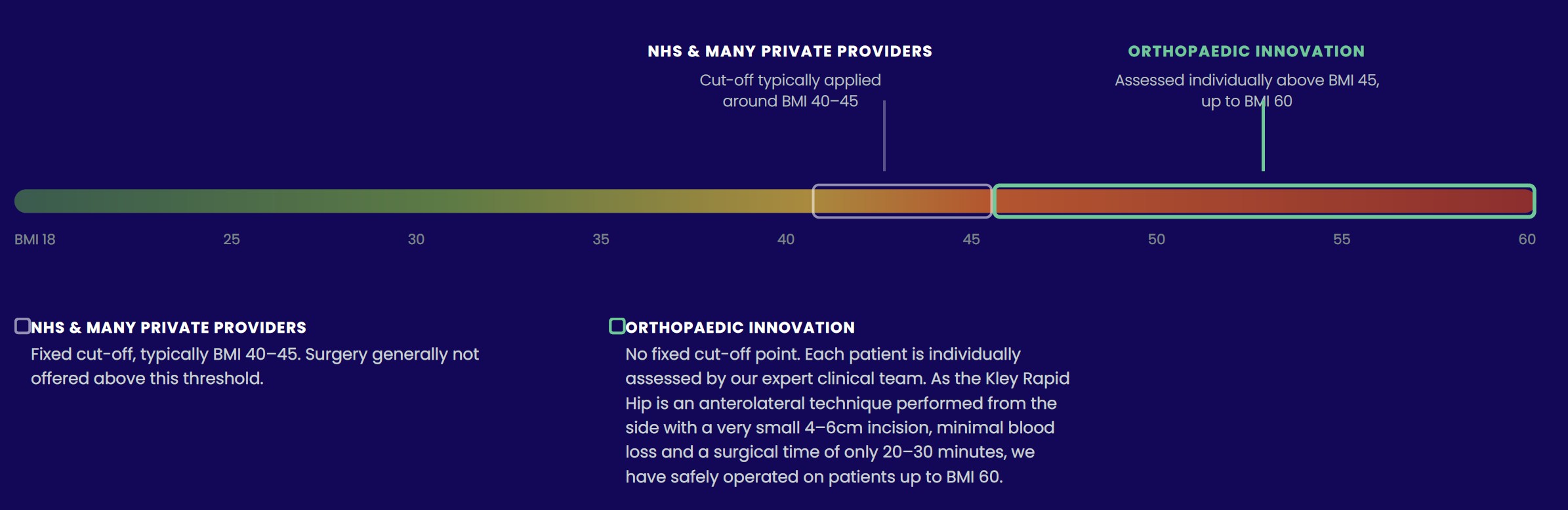
Do you have to be below a certain BMI to have hip replacement?

Where BMI cut-offs typically sit
Illustrative — individual clinical assessment always applies
Graph showing Orthopaedic Innovation BMI cut-off: No fixed cut-off point. Each patient is individually assessed by our expert clinical team. We have safely operated on patients up to BMI 60.
Thresholds shown are illustrative of typical provider policy and are not drawn from a single published source.
Individual eligibility at Orthopaedic Innovation is always confirmed by consultant assessment, not by BMI figure alone.

What if you've been told to lose weight before surgery?

Weight can affect the risks and complexity of hip replacement surgery, and losing weight may be recommended where appropriate. But there isn't a single BMI number that can tell us everything we need to know about an individual patient.

If you've been told you're not suitable for surgery because of your weight, a specialist assessment can help you understand why, what risks apply in your particular case, and whether there are other options worth considering.

Expertise You Can Trust: Meet Your Hip Surgeons

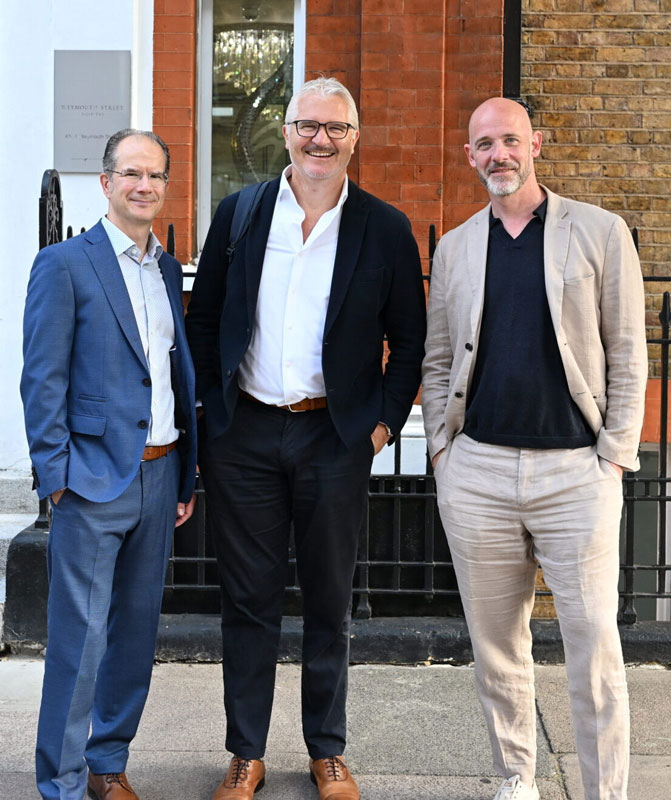
Our Hip surgical team is led by Dr Kristian Kley, an internationally recognised consultant with decades of experience in complex hip and knee surgery. Together with Professor Adrian Wilson and Dr Michael Sostheim, they frequently treat high-risk patients and have pioneered surgical techniques that make the Kley Rapid Hip possible across a broad range of cases.

Together, they work as a close-knit team—consulting on complex cases, operating together and ensuring that every patient receives a tailored treatment plan based on the latest surgical innovation.

If you’ve been turned away before, we encourage you to get in touch. A second opinion could be the first step toward getting your life back.
Highly rated on Google -
See what our patients have to say

Posted on Google Google
Pera Vlaic profile picture
Pera Vlaic
19 September 2026
Google star 1Google star 2Google star 3Google star 4Google star 5Trustindex verifies that the original source of the review is Google.
I travelled all the way from Croatia to London to seek a second opinion regarding problems with both of my hips, and I couldn’t have chosen a better place. From the moment we arrived, the whole experience felt warm and welcoming. Vlado and Marco made us feel immediately at ease with their friendliness, openness and genuine hospitality — not to mention the lovely coffee they welcomed us with. The consultation with Dr Kristian Kley was an equally positive experience. One of the nicest touches was that he even greeted me in my own language when I arrived, which immediately made me feel comfortable and cared for. The consultation itself was extremely pleasant and thorough. Dr Kley explained my condition and the possible approach to treatment in a very clear and simple way, making everything easy to understand. He inspires confidence and, importantly, takes the time to listen and answer questions. I am very grateful for the care and professionalism I experienced throughout my visit. I would wholeheartedly recommend this clinic to anyone looking for expert care, a warm approach and a truly positive patient experience. A grateful patient from Croatia, Pera Vlaić
Posted on Google Google
maria gomez profile picture
maria gomez
16 September 2026
Google star 1Google star 2Google star 3Google star 4Google star 5Trustindex verifies that the original source of the review is Google.
I had a really positive experience with the Professor Wilson and his fantastic team, including his PAs, Vlad and Marco. From the very beginning, they were all incredibly friendly, professional and approachable towards me. They took the time to listen, explain everything clearly and make sure I felt comfortable and well informed throughout. I really appreciated how welcoming and respectful everyone was, and it was clear that they genuinely care about their patients and the quality of care they provide. Vlad and Marco very helpful and always so friendly and attentive. The whole team worked extremely well together, which made the experience feel smooth and reassuring. I’m very grateful for the care and support I received and would definitely recommend Professor Wilson and his team to anyone looking for excellent orthopaedic care.
Posted on Google Google
aisha profile picture
aisha
16 September 2026
Google star 1Google star 2Google star 3Google star 4Google star 5Trustindex verifies that the original source of the review is Google.
I was seen at very short notice for excruciating hip pain and was extremely impressed with the care and treatment I received. Professor Wilson was professional, knowledgable and reassuring. He took the time to explain everything to me clearly. Most importantly, my hip pain has now completely gone, which I am incredibly grateful for. The whole team were very supportive and welcoming throughout, with a special mention to vlad, who was particularly helpful and supportive.
Verified by Trustindex
Trustindex verified badge is the Universal Symbol of Trust. Only the greatest companies can get the verified badge who has a review score above 4.5, based on customer reviews over the past 12 months. Read more

Have you already been told no?

If any of this sounds familiar, it's worth a conversation.
  • "You're too heavy."
  • “Lose weight and come back.”
  • “Your BMI is too high for surgery.”
  • “You're too high risk.”
  • Stuck between pain and a weight-loss target.
  • Ready for a second opinion.
Before you assume hip replacement isn't an option, get a specialist opinion.

WHY BMI ALONE DOESN'T RULE YOU OUT WITH US

The technique matters
more than the number on its own

Higher BMI raises real surgical considerations — anaesthetic risk, wound healing, and implant positioning among them. The Kley Rapid Hip approach has features that may be particularly relevant when assessing patients with higher BMI, including a short surgical time, minimally invasive access and early mobilisation.

Surgical time is typically around 20–30 minutes, versus roughly 90 minutes for a traditional posterior approach — time under anaesthetic is one of the main risk factors anaesthetists weigh up for higher BMI patients.

No muscles are cut and reattached during the procedure. This can support faster mobilisation and wound healing, which are both areas of extra caution at higher BMI.

Two expert surgeons are present for your procedure, with a pre-operative computer-planned simulation of your specific case.

Many patients go home within 24 hours of surgery. If a higher BMI means a longer stay is more appropriate for you, that's built into your individual plan, not treated as a reason to decline treatment outright.

FAQS: BMI & eligibility, answered directly

At Orthopaedic Innovation we have no fixed cut-off point for BMI. Each patient is individually assessed by our expert clinical team. As the Kley Rapid Hip is an anterolateral technique performed from the side with a very small 4–6cm incision, minimal blood loss and a surgical time of only 20–30 minutes, it can be safe option for a wide tange of patients. We have experience assessing and treating patients with BMI levels up to 60.

Suitability is always determined by individual consultant assessment. Higher-BMI patients who've been declined elsewhere are often still able to be considered here — subject to your surgeon's assessment of your individual case.

Yes it is possible however higher BMI raises real surgical considerations — anaesthetic risk, wound healing, and implant positioning among them. The Kley Rapid Hip approach was developed to reduce several of those risk factors directly, which is why individual assessment, rather than a blanket cut-off, is possible.

No. You don't need to reach a particular BMI simply to speak to our team. Your suitability for surgery will be assessed during your consultation, what risks apply in your particular case, and whether there are other options worth considering.

There is no single BMI threshold that applies to every patient at Orthopaedic Innovation. We assess each person individually.

Higher BMI raises real surgical considerations — anaesthetic risk, post operative fracture, wound healing, and implant positioning among them. The Kley Rapid Hip approach was developed to reduce several of those risk factors directly, which is why individual assessment, rather than a blanket cut-off, is possible.

If another surgeon or hospital has told you that your BMI or other health factors make you unsuitable, we can provide an independent specialist assessment. This doesn't mean surgery will be recommended, but it can give you a clearer understanding of your options.

Recovery varies from person to person. Higher BMI can affect factors such as wound healing, mobility and other aspects of recovery, which is why your surgeon will create an individual plan based on your circumstances.

Because our approach is designed specifically around minimally invasive access, it can reduce the risks traditionally associated with hip surgery as it focuses on preservation of major muscle groups and encourages early mobilisation. All these factors also help with the recovery process.

More complex cases will require individual pricing. After your consultation and health assessment, the price for surgery will be dicussed and a personalised all-inclusive package will be put together with transparent pricing. Please see our hip pricing page for more information about how our pricing works.

This is a self pay service. Please contact us for further details about payment and payment plans.

We accept WPA and some international insurances.

If our team decides that surgery isn't appropriate for you, we'll explain why and discuss the options available based on your circumstances. A consultation isn't a commitment to surgery.

Your first consultation will be with one of our expert surgeons. You can choose between in-person appointments at our Harley Street clinic or online appointments.

During the consultation your surgeon will review your medical condition and health history and discuss the best treatment options for you. He will also answer any question you have about hip replacement surgery or any of the other options.

An overnight stay is included in your package. The majority of patients stay overnight and are discharged the next day. Some more complex cases may require two nights in hospital. This will be discussed as part of your treatment plan.

If you’ve been told by other doctors that you’re not suitable for hip replacement surgery, you might find that the Kley Rapid Hip procedure is suitable for you. At your first consultation, your surgeon will give you a personalised assessment, and will be able to discuss your specific case and discuss the options with you.

  • Post-operative consultation with your surgeon.
  • As required, in-hospital monitoring.
  • Post-Operative routine physio appointment
  • Physio protocol guide
  • 2 week nurse follow-up
  • 6 week consultant follow-up with your surgeon.

While the likelihood of major complications following a rapid recovery hip replacement is low, it’s important to be aware of the potential risks involved. Here’s what you need to know:

  • Infection: Though rare, infections can occur either at the wound site or around the implant. Under Dr. Kley’s care, the infection rate is impressively low, with only 3 cases in the past 15 years, less than 1%. By comparison, the national average for infections with traditional hip replacement surgery is 1-5%. Our rigorous protocols before, during, and after surgery help minimise this risk further.
  • Blood Clots: Any surgery carries a risk of blood clots, such as deep vein thrombosis (DVT) or pulmonary embolism. However, the Rottinger approach significantly reduces this risk by allowing patients to move sooner after surgery, as movement is key in preventing clots.
  • Dislocation: Nationally, the dislocation rate for first time hip replacements is  2%. With the Kley Rapid Hip technique, there have been no recorded dislocations under Dr. Kley’s care.
  • Implant Loosening: Implants are designed to last at least 10 years, with many lasting up to 20 years based on recent data. A small percentage of all implants may loosen prematurely, but this risk remains very low.
  • Fracture: Although extremely rare, fractures can occur during or after surgery. If a fracture does happen, it is addressed during the procedure or with further surgical intervention if it occurs in the weeks following surgery. The chance of a fracture with this approach is significantly less than 1%.
  • Nerve and Vessel Damage: This approach reduces the risk of nerve or vessel damage by positioning the surgical field away from major nerves. Unlike anterior and posterior techniques, the rapid recovery approach avoids proximity to the femoral and sciatic nerves.

No recorded nerve or vessel injuries in the last 15 years at Dr Kley’s practice having performed over 3,000 hip replacements.

With the rapid recovery technique, you will benefit from an advanced surgical procedure that prioritises safety and minimise risks, ensuring the best possible outcomes for you.

All of the risks of surgery will be discussed in detail with you by your surgeon as part of the consenting process. This will be dependent on your individual medical history and the above should only be taken as a generic summary.

You don't have to decide about surgery today.

Your first step is simply a conversation and finding out whether you have options.
  1. Book a free discovery call
  2. Tell us about your hip and your previous treatment
  3. Our team reviews your circumstances
  4. If appropriate, we'll arrange a specialist assessment
  5. You'll receive a clear explanation of your options
No obligation to proceed with surgery.

Or call to speak to our specialist team:

Related articles

Download our free guide to Rapid Recovery Hip Replacement surgey

  • Learn about the hip and why you might need hip replacement surgery.
  • Explore the details of rapid recovery hip replacement surgery
  • How the operation is performed
  • Recovery from your day surgery
  • Learn more abouty your patient journey with Orthopaedic Innovation
By downloading this guide we will add you to our email marketing list. You can unsubscribe at any time.
Locations

Outpatient Clinic
Phoenix Hospital Group,
9 Harley Street,
London, W1G 9QJ
Inpatient
Weymouth Street Hospital,
42-46 Weymouth St,
London, W1G 6NP
Outpatient Clinic
Minor Procedures
25 Harley Street,
London, W1G 9QJ
Medical disclaimer
The information provided on this website is for informational purposes only and should not be considered medical advice. It is not intended to replace consultation with a qualified healthcare professional. While we strive to provide accurate and up-to-date information, medical knowledge is constantly evolving, and individual cases may vary. Any surgical or non-surgical treatments discussed on this website should be considered in consultation with a medical professional who can assess your individual needs and medical history.
Use this form to request a free call back from one of our team to discuss any questions you might have.
1
Contact
2
Condition
3
Callback
Are you currently on the NHS waiting list for your condition?
Phone call
Preferred callback time
Preferred day
Email marketing