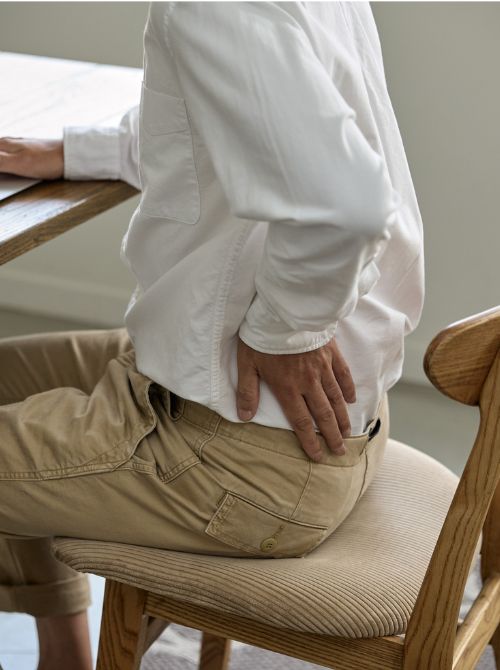
Piriformis syndrome produces sciatic-type symptoms from nerve irritation at the hip, rather than from a compressed nerve root in the lumbar spine. A careful clinical assessment distinguishes it from lumbar disc disease, hip joint pathology (FAI, labral tears), and other causes of buttock and leg pain.
No associated low back pain
Most piriformis cases occur without back pain, whereas lumbar sciatica usually does involve it.
What triggers the pain
Symptoms are worsened by sitting, rather than primarily by bending forward or coughing and sneezing, as in lumbar disc disease.
Positive FAIR test
Flexion, Adduction, Internal Rotation of the hip reproduces symptoms by stretching the piriformis over the sciatic nerve.
Normal lumbar spine imaging
Unlike lumbar sciatica, piriformis syndrome isn't linked to a disc problem in the spine that would explain the leg pain.
Anatomical variation
In some people, the sciatic nerve runs through the piriformis muscle instead of underneath it, a natural anatomical variation that makes the nerve more prone to irritation.
Muscle overuse or spasm
Runners, cyclists, and those who sit for prolonged periods are commonly affected. Sudden increases in training load or changed sitting posture frequently trigger symptoms.
Underlying hip pathology
Hip joint problems, such as FAI or early arthritis, can force the piriformis muscle to work harder to stabilise the hip, leading to overuse. This is an important factor to consider. Treating piriformis syndrome without identifying and addressing an underlying hip problem may only bring partial or short-lived relief.
Direct trauma
A fall onto the buttock can cause piriformis injury or haematoma.
Sciatic-type radiation
Pain, numbness, or tingling running down the back of the thigh, sometimes into the calf and foot, mimicking sciatica from a herniated disc.
Pain aggravated by sitting
Particularly on hard surfaces, during prolonged car journeys, or when crossing the legs, the piriformis is compressed between the sitting surface and the sciatic nerve.
Pain aggravated by hip external rotation activities
Stair climbing, walking uphill, and activities involving outward rotation of the hip.
Buttock pain
Deep, aching pain in one buttock, not always radiating further.
Tenderness deep in the buttock
Pressing over the deep buttock in the region of the piriformis muscle reproduces the pain.
Clinical history
The pattern of symptoms, their relationship to sitting and activity, and the absence of lumbar spine symptoms.
Examination
This includes a series of specific tests along with pressing on the piriformis muscle and an assessment of hip range of motion.
Lumbar spine assessment
To exclude a lumbar disc or nerve root cause of the symptoms.
Hip assessment
To identify any underlying hip joint pathology contributing to piriformis overload.
MRI
Not always needed, but can exclude other causes and may show piriformis muscle changes or fluid in the sciatic notch.
Physiotherapy
This is the main treatment for piriformis syndrome. This typically includes targeted stretching of the piriformis muscle, techniques to help the nerve move more freely, and correcting the movement patterns that are causing the muscle to overwork. Most patients with genuine piriformis syndrome respond well to a structured physiotherapy programme.
Activity modification
In the early stages, reducing or adjusting the activities that are overloading the muscle, typically prolonged sitting, running, or cycling, while physiotherapy takes effect.
Corticosteroid injection
For more significant cases, an ultrasound-guided injection into the piriformis muscle or the nearby sciatic notch can provide meaningful pain relief, making it easier to engage fully with physiotherapy.
Botulinum toxin injection
For cases that haven't responded to other treatments, an ultrasound-guided injection of botulinum toxin into the piriformis muscle can help relax the muscle and has been used with good results.
Addressing underlying hip pathology
Where hip joint disease (FAI, early arthritis) is contributing to piriformis syndrome, addressing the underlying hip problem may be necessary for lasting resolution